
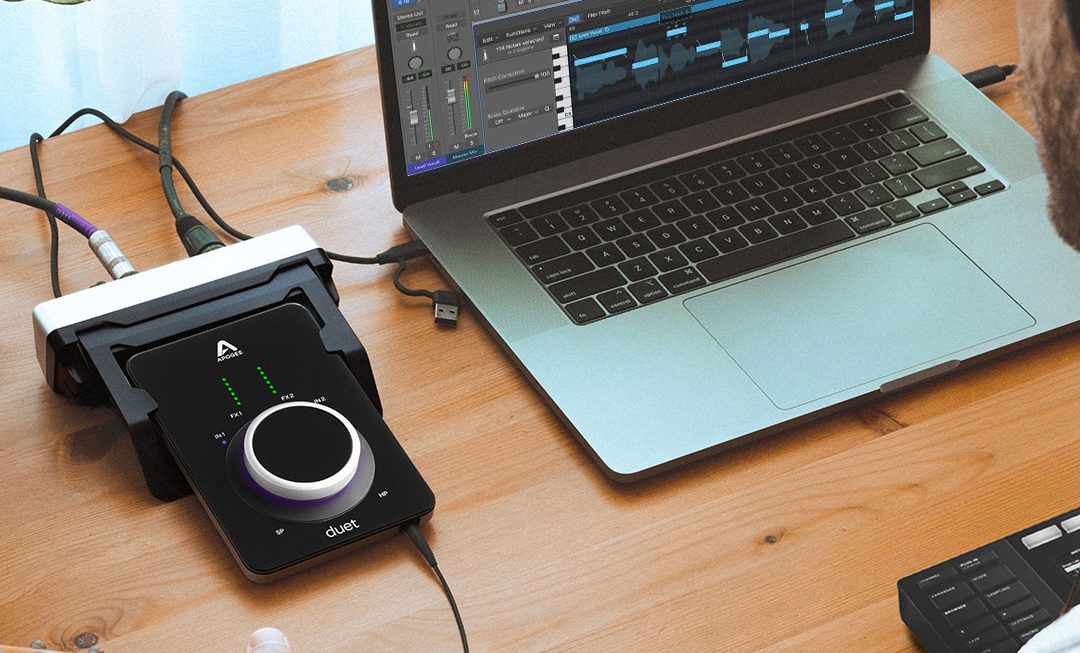
A premium interface deal only matters when it changes who can buy the gear, not when it shaves a few dollars off a luxury item. The Apogee Duet 3 is getting fresh attention because a piece of studio hardware that often sat above casual home setups is now being judged by a wider group of creators. For U.S. musicians, podcasters, voice actors, and bedroom producers, that shift is the whole story. The question is not whether the discount looks flashy. The better question is whether this small box fixes the exact weak point in your recording chain. Apogee lists the unit as a 2×4 USB-C model with two studio-grade preamps, bus power, hardware DSP, and recording support up to 24-bit/192kHz, which places it above the cheap starter tier in both design and intent. If you already follow audio gear price alerts, this is the kind of drop worth slowing down for because the real value sits in conversion quality, monitoring confidence, and how often you record away from a full desk setup.
Why the Apogee Duet 3 Price Drop Matters for Small Studios
Price is not the only reason people hesitate on premium audio gear. The deeper friction is trust. A small studio owner in Austin, a singer in Nashville, or a podcast editor in Chicago has to ask whether one polished interface can earn space beside microphones, headphones, acoustic panels, cables, and software bills. A lower price changes that math, but it does not erase the need for judgment. It also shifts the product from “someday gear” into the same conversation as the midrange boxes people were already ready to buy.
The old premium gap finally feels smaller
For years, the Duet line carried a certain weight. It was not the anonymous black box you bought because it was on a shelf at a big-box store. It was the interface people talked about when they cared about clean conversion, portable sessions, and the feel of a more serious front end. That reputation helped it, but it also made buyers cautious.
A price drop matters because the home recording market has moved. Many creators now run full client work from a spare bedroom. A voice actor might record auditions between school pickup and dinner. A guitar player might track paid parts at a kitchen table while watching levels on a laptop. In that world, a USB audio interface has to feel less like a toy and more like a quiet partner.
The non-obvious point is that a discount can make people more selective, not less. When a premium model moves closer to midrange pricing, buyers start comparing it with cheaper boxes they already know. That forces the Duet 3 to win on feel, noise, output quality, and daily ease, not brand glow.
A cheaper interface can still be the right buy. No serious editor should pretend otherwise. But once the gap narrows, a buyer can ask a sharper question: do I want more inputs that I may never use, or fewer channels that sound and feel better every time I sit down?
Where the deal changes the buyer math
A $699 list price still appears on Apogee’s own store page, while Apple has shown the product at $649.95 and B&H has listed it at $699, so any deal below that range should be judged against known retail pricing rather than a vague “sale” label. The 2025 anniversary rollback to $495 also gives shoppers a useful reference point for how far a public promotion has gone before.
That does not mean every lower tag is an instant buy. Used listings, open-box units, missing breakout cables, no return window, and dock bundles can blur the picture fast. A home studio interface becomes a bad deal when you save $80 but spend weeks chasing a bad cable or a noisy headphone jack.
Here is the practical test: would the lower price free up money for the rest of the recording chain? If the answer is yes, the deal gets stronger. A New York singer who buys the interface and still has money left for a better pop filter, a stand, and a quiet USB-C cable may end up with cleaner results than someone who spends the whole budget on one shiny unit.
The smarter buyer also checks timing. Music gear deals often look better before holidays, school seasons, and studio upgrade cycles. If a lower price arrives while you already need an interface, that is useful. If it creates a need you did not have yesterday, the deal is doing the shopping for you.
What You Actually Get Beyond the Discount
The best reason to care about this deal is not the discount itself. It is the feature mix. The Duet 3 sits in a strange but useful lane: small enough for a backpack, serious enough for paid vocal, guitar, podcast, and writing sessions, but not built for tracking a whole band at once. That narrow focus is a strength when you know what you need. It keeps the design aimed at a creator who records with care, not a room full of people patching cables at once.
Portable recording interface features that count at home
A portable recording interface should not mean “smaller at any cost.” The useful version gives you clean inputs, stable monitoring, enough gain for common microphones, and fast setup without turning the desk into a cable nest. Apogee’s official product page lists up to 65dB of mic preamp gain, 48V phantom power, two instrument inputs, two balanced outputs, bus power, and onboard DSP for low-latency recording with Apogee FX.
That matters in normal U.S. homes because most rooms are not treated like studios. The interface cannot remove a loud air conditioner in Phoenix or a truck passing outside a Brooklyn apartment. But cleaner gain and steadier monitoring help you make better choices before the recording is ruined. You hear mouth noise sooner. You catch guitar buzz before the second take. You stop blaming the microphone for problems that started at the input.
The counterintuitive part: the fancy features are not always the reason to buy. For many people, the win is boring. It is the moment you plug in, set a level, and stop wondering if the gear is adding a veil over your voice. That kind of confidence saves more time than another plugin bundle.
Monitoring deserves its own mention because it changes behavior. When the headphone output feels clear and the input level responds in a predictable way, you perform with less doubt. A singer may lean into a softer line. A narrator may catch plosives before the client does. Those little corrections rarely show up on a spec chart, but they show up in the final file.
Why the breakout cable is both smart and annoying
The Duet 3 keeps its body thin by moving several connections to a breakout cable. Apple’s product page lists the interface, breakout cable, carrying case, and USB Type-C/A cable in the box, while Apogee also lists the breakout cable and travel case as included items. This setup is clever for travel because the main unit stays compact and clean on a desk.
It can also irritate people who leave everything plugged in. A producer in Los Angeles who moves between a laptop bag and a writing desk may love the small body. A podcaster in Ohio who never leaves the same room may wish every input lived on the box itself. Neither person is wrong. They are buying for different habits.
This is where many reviews miss the daily truth. Portability is not always freedom. Sometimes it means one more cable to protect. If you are hard on gear, have pets near the desk, or record in shared spaces, that breakout cable should be part of your buying decision, not an afterthought.
There is a flip side. A breakout cable can keep the main unit away from the tug and weight of several plugs. On a cramped desk, that can make the interface easier to place near a laptop while the heavier connections sit farther back. It is not perfect, but it has a logic that makes sense once you work in tight spaces.
Who Should Buy Before the Price Moves Again
A deal is only useful when the gear matches the work. The Duet 3 is not a universal answer, and that is fine. In fact, its appeal gets clearer once you stop treating it like a product for everyone. It makes the most sense for people who record one or two sources at a time and care more about capture quality than input count. That buyer is common now: one person, one laptop, one mic, one idea that needs to sound finished enough to share.
Singer-songwriters, podcasters, and guitar players with one desk
This is the sweet spot. A singer-songwriter can keep one vocal mic and one guitar input ready. A podcaster can run a solo mic and leave room for a guest if the setup stays simple. A guitar player can record direct parts, monitor through headphones, and move between a bedroom, hotel room, or rehearsal space without packing half a rack.
For these users, a portable recording interface feels less like a compromise. It becomes the center of a small rig. You do not need eight inputs to record a vocal demo at midnight in Dallas. You need a quiet chain, a clear headphone feed, and a setup that does not fight you when the idea is fresh.
One specific example: a freelance voice artist working from a treated closet can pair this with a dynamic mic and record paid auditions without building a large desk. The interface’s small footprint matters because that closet may also hold clothes, blankets, and a laptop stand. Space is not a style choice there. It is the room you have.
The same applies to students in dorms and apartment renters who cannot mount panels or leave a full rig out. A smaller box that packs away cleanly may get used more often than a larger setup that feels like a chore. Consistency beats ambition when the goal is to finish work.
Who should pass and buy more inputs instead
Drummers, live worship teams, small band engineers, and people who record several guests in person should pause. Two inputs can feel fine on Monday and tiny by Friday. If you need four microphones every week, a cheaper box with more inputs may serve you better than a premium two-input unit.
This is not a knock on the Duet 3. It is the wrong tool test. A home studio interface for a solo creator has a different job than one built for group tracking. The first needs polish and speed. The second needs channel count, routing space, and a layout that survives a messy session.
The hidden cost of buying too little input count is not the next interface. It is the workarounds. You start recording guests one at a time. You borrow mixers. You patch gear in ways that make troubleshooting harder. Then the discount starts to look smaller because your workflow costs more energy.
There is also a learning curve hidden inside premium simplicity. If you prefer lots of physical buttons, separate knobs for each task, and fewer software settings, the Duet approach may feel too minimal. That is not a flaw for everyone, but it is a real preference. Gear should fit your hands as well as your ears.
How to Judge the Deal Without Getting Pulled Into Hype
Hype loves a low number. Good buying takes a wider look. Before you click checkout, treat the sale like a short interview. Ask what comes in the box, who backs the warranty, whether returns are easy, and whether the seller is authorized. That sounds plain. It also saves buyers from the most common audio gear regret. The goal is not to win the internet’s best deal. The goal is to buy once and record without nagging doubts.
Check the bundle, return window, and dock
The Duet Dock can make the interface feel more permanent on a desk, but it may change the real price. Some listings sell the interface alone. Others bundle the dock. Sweetwater has listed a dock bundle at $898, while the standalone interface has appeared at $699 on major U.S. retail pages.
That matters because “lowest price” can hide a missing piece or a different kit. If one retailer sells the unit alone for less and another charges more with the dock, the cheaper option may still be right for a traveler. A desk-based producer may prefer the bundle if it keeps cables cleaner and the unit easier to grab.
Use a small checklist before buying:
- Confirm the breakout cable is included.
- Check whether the dock is part of the price.
- Read the return window before opening software offers.
- Make sure the seller is known for audio gear support.
- Compare final cost after tax and shipping.
A sale that fails two of those checks is not a bargain. It is homework.
Also watch the wording around “open box,” “used,” “refurbished,” and “new.” Those labels do not mean the same thing. A true new unit from a trusted seller has a different risk level than a marketplace listing with missing packaging and no clear return route.
Compare the sound problem you need to solve
Most people shop interfaces backward. They start with brand, price, and YouTube opinions. Start with the sound problem instead. Are your vocals noisy? Are your headphones weak? Are your guitar tracks dull? Does your current box crash when the session gets crowded? Each problem points to a different answer.
The Duet 3 makes the strongest case when your weak link is clean capture and trustworthy monitoring. Apogee’s own page focuses on conversion, two preamps, low-latency monitoring, Mac, iOS, and Windows support, plus bus power for mobile use. That lines up with solo creators who want a better front end without building a large studio.
For more buying help, compare it against your broader home studio upgrade checklist and your portable recording setup guide. The right question is not “Is this the best interface?” It is “Does this solve the problem I hear every week?” That question cuts through the noise fast.
One more test helps: name the first project you will record with it. A vocal EP, a podcast season, a paid voiceover batch, a guitar course, a remote writing session. If no project comes to mind, wait. A deal tied to real work is useful; a deal tied to vague gear hunger is expensive.
Conclusion
The smartest buyers will treat this price move as an opening, not a command. A lower tag can make premium gear easier to justify, but it does not change your room, your microphone, your habits, or your need for the right input count. For the right buyer, the Apogee Duet 3 sits in a useful middle space: more serious than a starter box, far smaller than a studio rack, and focused on the few channels many creators use every day. The best fit is the solo musician, podcaster, voice artist, or producer who wants cleaner capture without turning a small workspace into a gear pile. Check the seller, check the bundle, and check the return policy before you celebrate the discount. Then ask the only question that matters: will this help you record more work you are proud to send out? If the answer is yes, this is the kind of deal worth acting on.
Frequently Asked Questions
How much should I pay for the Duet 3 on sale?
A strong sale should land well below the common $649–$699 retail range seen at major sellers. The older $495 anniversary promotion is a helpful reference point, but final value depends on condition, bundle contents, return policy, and whether the breakout cable is included.
Is the Duet 3 worth it for a beginner home studio?
It can be worth it for a beginner who cares about vocals, guitar, podcasting, or voice work and wants gear they will not outgrow fast. A cheaper interface may make more sense if you are still testing the hobby or need more inputs.
Does the Duet 3 work well for podcast recording?
It works well for solo podcasts and simple two-person setups. The clean preamps, compact body, and headphone monitoring suit desk-based speech recording. For three or four guests in the same room, choose an interface with more microphone inputs.
What makes this interface different from cheaper models?
The main difference is the focus on conversion quality, preamp quality, monitoring feel, and portable design. Cheaper models may offer more inputs, but they often lack the same sense of polish in capture, output, and build.
Can I record guitar and vocals at the same time?
Yes, the interface can handle two sources, so a vocal mic and guitar input can work together. You will still need a good microphone, proper gain settings, and a room quiet enough to keep bleed and background noise under control.
Do I need the Duet Dock?
You do not need it to record, but it can make a fixed desk setup feel cleaner. Travelers may skip it. Producers who leave monitors, headphones, and inputs connected may like the dock because it reduces cable clutter.
Is the Duet 3 good for Windows users?
It supports Windows 10 Anniversary Update or later according to Apogee’s compatibility information. Windows buyers should still check current driver notes before purchase, especially if they use older machines, uncommon DAWs, or strict studio software setups.
What should I check before buying an open-box unit?
Confirm the breakout cable, case, and USB cable are present. Ask about registration status, warranty coverage, and returns. Open-box can be a smart buy, but missing accessories can erase the savings fast.